
2026 and beyond: Why smart entrances are becoming non-negotiable in South Africa and Africa
2026 and beyond: Why smart entrances are becoming non-negotiable in South Africa and Africa
March 2, 2026
In South Africa, the entrance to a building is no longer just a doorway, it’s a pressure point. Whether it’s an office lobby in Sandton, a logistics facility in Durban, a shopping centre in Lusaka, a private estate in Johannesburg, or a construction site that changes week by week, businesses are under growing pressure to control who comes in, how they move, and what gets recorded, without slowing operations down.
And as we head into 2026, entrances are being treated less like “security infrastructure” and more like operational systems. The question is no longer “Do we need access control?” but rather “How do we control access properly, consistently, and at scale?” Two forces are driving this shift.
First, security risk remains persistent. South African organisations continue to invest in layered security and stronger access control at entry points. Second, entrances are expected to do more than security. Modern access solutions must also support compliance, visitor management, staff flow, contractor control and even energy efficiency – particularly in high-traffic buildings.
That is why turnstiles, speed gates, revolving doors, access control booths/mantraps, and increasingly containerised entrance control, are becoming core infrastructure for these businesses.
Access control is expanding globally – and Africa is following
Globally, physical access control and turnstile systems are growing rapidly as organisations modernise their security and operational control. In 2024, the global turnstile access control market was valued at approximately USD 1.98 billion, with strong growth projected through the decade as more sectors adopt automated access solutions.
Other forecasts estimate the broader turnstile gates and access control market will grow from around USD 1.2 billion in 2024 to roughly USD 2.4 billion by 2033, at an annual growth rate of about 8.5%.
Even more importantly, access control barriers such as turnstiles and gates are now considered part of a significant portion of access control projects globally, showing that controlled entrances are becoming the standard rather than the exception. For Africa, this trend is being accelerated by urbanisation, commercial development, the expansion of private estates, and the growing need to protect people and assets in higher-risk environments.

From “guards and gates” to measurable, auditable access
The biggest shift across South Africa is the move away from purely people-driven security to systems-driven access control. Turnstiles, speed gates and mantraps are no longer standalone barriers, they’re integrated with access control software, biometrics, visitor management platforms, and time-and-attendance systems.
Flow Systems specifically positions its solutions as integratable with access control and time & attendance systems and a wide range of verification methods, including card and multiple biometrics. This matters because once access becomes measurable, it becomes manageable. It reduces grey areas, improves accountability, supports incident investigation, and makes compliance easier.
Speed gates and prestige entrances are rising in corporate and public-facing environments
South African businesses look for entrance control that balances security with experience. This is where speed gates and prestige turnstiles are growing rapidly – particularly in corporate offices, banks, mixed-use developments, and premium retail environments. These solutions help reduce tailgating while maintaining a clean, modern aesthetic.
Flow Systems’ prestige turnstiles are designed specifically for corporate, banking and prestige entries, alongside speed gates, service doors and booths to create secure environments without sacrificing design.

Revolving doors are now both a security and efficiency decision
Revolving doors are often assumed to be purely architectural, but their role in 2026 is far more functional. Revolving doors help control pedestrian flow while also reducing unwanted airflow, which is an increasingly important consideration in large commercial buildings trying to manage energy costs and indoor climate control.
Flow Systems offers manual, automatic and access-controlled variants across multiple sizes.
For high-traffic entrances, this makes revolving doors a practical investment, not just a design statement.
High-security booths and mantraps for higher-risk facilities
Where risk is higher, including certain industrial sites, cash environments, controlled-entry facilities, or critical infrastructure, access control booths and mantraps remain one of the most effective solutions. These systems enforce strict entry protocols such as “one person at a time” access, reduce forced entry risk, and create a controlled checkpoint that supports both security and compliance.
Flow Systems supplies booths, cubicles and mantraps designed specifically for high-security areas.
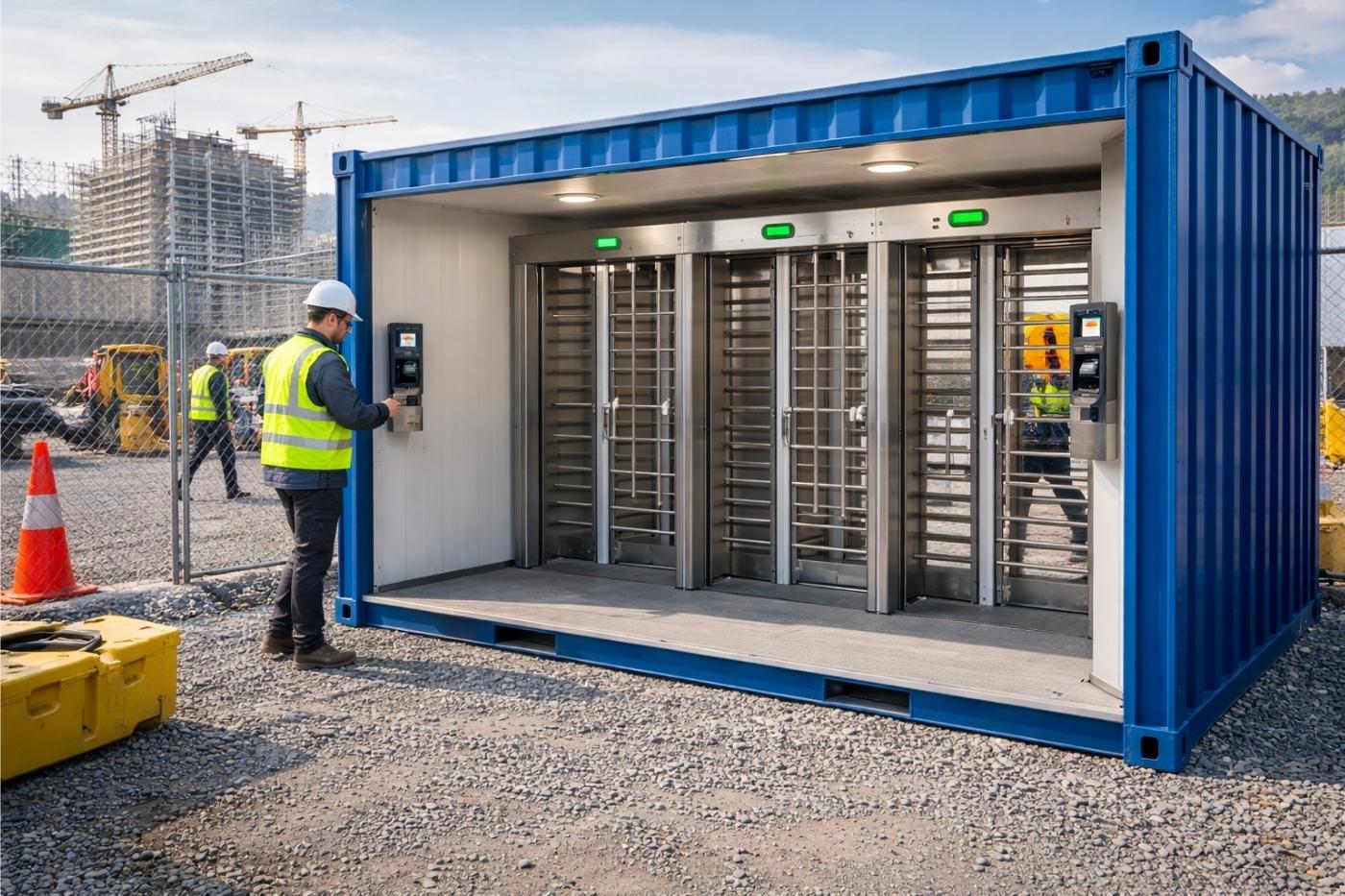
Containerised access control is becoming standard for temporary and remote sites
This is one of the biggest shifts we’re seeing in South Africa and across Africa: projects are increasingly distributed, mobile, and time-bound. Construction sites, mines, remote depots and temporary facilities need the same access integrity as permanent buildings, without requiring permanent infrastructure.
Flow Systems explicitly addresses this, describing modern turnstile systems that are now used beyond permanent entrances, including portable container-based access control solutions.
So why are organisations investing in these systems?
Across offices, estates, malls, industrial sites and construction projects, the reasons are consistent: Businesses want to reduce unauthorised access and tailgating, improve visitor and contractor control, create audit trails, strengthen safety, and reduce operational disruption.
Local access control providers also reinforce that turnstiles are widely used in offices, universities, airports and transport environments because they prevent unauthorised entry, control flow, and integrate with modern access control systems.
Why count on Flow Systems for 2026 and beyond?
Choosing entrance control infrastructure isn’t only about selecting a product, it’s about selecting a partner. Flow Systems manufactures and supplies a broad range of solutions including industrial and prestige turnstiles, speed gates, revolving doors, and access control booths, with a focus on robust integration and long-term performance. For South African and African conditions, Flow Systems’ offering reflects the reality of the market: you need solutions for both permanent buildings and rapidly changing sites – including container-based deployments.
If you’re planning upgrades or building new sites for 2026 and beyond, turnstiles, speed gates, revolving doors, access booths/mantraps, and containerised access control should be viewed as core operational infrastructure – not optional extras. And that’s exactly where Flow Systems adds value: entrance solutions engineered for real conditions, real throughput, and real accountability.
