
Manual or Automatic Revolving Doors for Modern Buildings
Manual or Automatic Revolving Doors for Modern Buildings
September 21, 2026
Revolving doors remain common because they solve several entrance problems at once. They let people enter and leave continuously while limiting direct exchange of indoor and outdoor air. They can also manage pedestrian movement, support access control and create a clear architectural focal point at the entrance.
The building team must choose the right operating method, diameter, number of wings, glazing, safety features and control strategy. A manual revolving door may suit a smaller office lobby with moderate traffic. A large automatic revolving door may be more appropriate where footfall is high, hands-free entry matters or the entrance forms part of a wider building management system.
What a revolving door system does
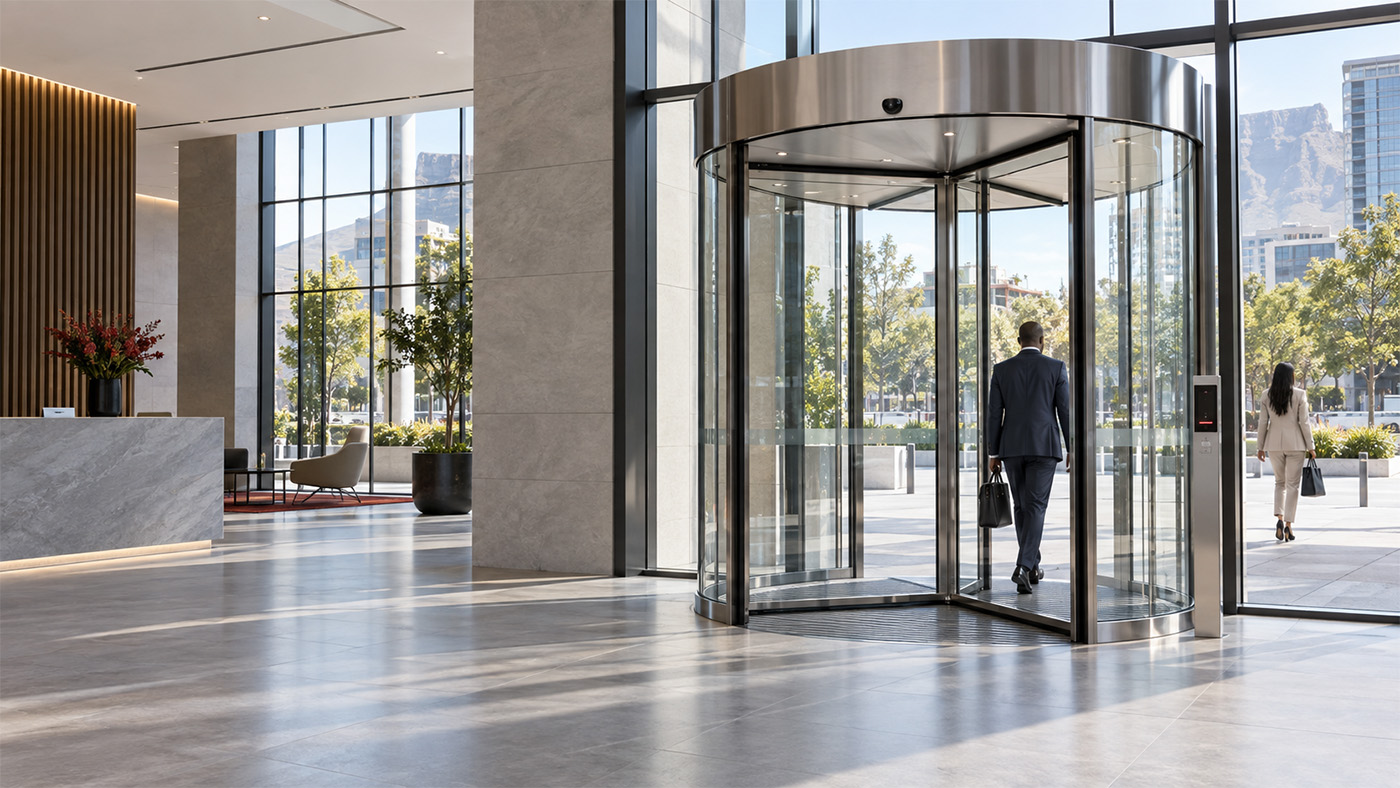
A revolving door system normally consists of a cylindrical enclosure, a central rotor and two, three or four door wings. As the wings rotate, they create moving compartments between the exterior and interior. People can travel in both directions without leaving one large opening exposed for the full duration of entry.
That distinction matters in an air-conditioned or heated building. A swing or sliding door creates a direct opening whenever it is used. A correctly specified revolving door keeps the entrance partitioned for most of its rotation, which can reduce uncontrolled air movement, draughts and the amount of dust or outside noise entering the lobby. Actual performance depends on door size, seals, traffic patterns, wind, pressure differences, and how people use the entrance.
A revolving door can be manual, power-assisted or fully automatic. Glass revolving doors may use framed or frameless construction, and the operating method is a separate choice.
Why revolving doors are still used
Revolving doors remain relevant in office buildings, hotels, healthcare facilities, airports, retail centres and other public or commercial entrances. Building teams continue to specify them for five practical reasons:
1. Indoor comfort
The compartmented design can reduce draughts and sudden temperature changes close to reception and waiting areas.
2. Pedestrian flow
Separate compartments allow people to enter and leave at the same time, provided the diameter and wing arrangement match the expected traffic.
3. Architectural presentation
Stainless steel, aluminium and glass options can be coordinated with the facade and lobby design.
4. Controlled entry
Selected systems can incorporate night locking, reader activation and interfaces with access control systems.
5. Entrance protection
The rotating arrangement can help buffer the lobby from wind, dust and exterior noise compared with an entrance that remains directly open during use.
These benefits depend on specification and operation. A door that is too small for the peak traffic, difficult to push or poorly maintained may encourage people to use an adjacent swing door instead. Entrance planning must therefore account for user behaviour as well as architectural appearance.
Manual revolving doors
A manual revolving door moves when the user pushes a door wing or push bar. It has no powered drive for normal rotation, although mechanical controls may regulate speed and return the rotor to a preferred resting position. Flow Systems offers manual revolving doors from 1.4 to 3 metres in diameter, with optional mechanical speed control, self-centring and mechanical locking.
Manual systems often suit office entrances, boutique hotels, restaurants and other buildings with moderate or intermittent foot traffic. They can reduce electrical and control complexity, but they are not maintenance-free. Bearings, locks, speed controls, seals, glazing and the surrounding structure still require inspection and servicing.
The main design question is user effort. The rotor must be easy to start and control without moving too quickly. Designers should consider older users, children, people carrying bags and anyone whose mobility makes a manually operated door difficult. Plan an appropriate accessible entrance as part of the complete entrance design.
Automatic revolving doors
An automatic revolving door uses a powered drive and sensors to control movement. Flow Systems offers a go-and-stop mode in which the door remains stationary until infrared sensors detect a pedestrian, as well as a continuous mode in which the door rotates slowly when unoccupied and increases to its normal operating speed when a pedestrian is detected.
Automatic operation is useful where traffic is frequent, hands-free movement is preferred, or the entrance needs a predictable operating pattern. Office towers, transport facilities, hospitals, hotels and busy commercial buildings may benefit, but the choice must be based on measured peak traffic and the people who will use the entrance.
Powered operation brings additional planning requirements. The design team must coordinate electrical supply, sensor coverage, safety controls, emergency behaviour, access control signals and preventive maintenance. Never select an automatic door solely because it appears more advanced. It must offer a clear operational benefit for the building.
Manual and automatic revolving doors compared
| Decision factor | Manual revolving door | Automatic revolving door |
|---|---|---|
| Normal operation | The user pushes the rotor | Sensors and a powered drive control rotation |
| Typical traffic | Moderate or intermittent movement | Frequent, sustained or high-volume movement |
| User effort | Physical push is required | Hands-free movement is possible |
| Controls | Mechanical speed control and self-centring may be added | Sensors, drive controls, emergency inputs and operating modes are coordinated |
| Power | No drive power for normal rotation | Electrical supply is required |
| Maintenance focus | Mechanical condition, locks, glazing, seals and speed control | Mechanical items plus sensors, controls, drive and electrical interfaces |
| Best fit | Smaller offices, hotels, restaurants and moderate-use entrances | Busy office lobbies, public buildings and entrances needing automatic operation |
Speed gates are ideal for environments where both security and presentation are important, including:
- Corporate offices and head offices
- Commercial buildings and business parks
- Airports and transport hubs
- Government and secure facilities
- High-end residential developments
Their ability to combine fast throughput with controlled access makes them a preferred solution in high-traffic areas.
Glass revolving doors and architectural design
Glass revolving doors are popular in office lobbies because they preserve sightlines and allow daylight to reach the entrance. They may be framed in stainless steel or aluminium or designed with a more minimal frameless appearance. Manual and automatic glass revolving doors can both be specified, so the visual concept does not determine the operating method.
The glazing specification must address more than appearance. The project team should confirm the type of safety glass, visibility markings, edge protection, door-wing construction and maintenance access. Reflections, lighting and background contrast also affect how easily users see the moving wings. Clear glass that looks elegant in a drawing still needs to be obvious to someone approaching the entrance.
Flow Systems manufactures revolving doors with steel, stainless steel and aluminium finishes and offers two-, three- and four-wing arrangements across selected models. Certain models can also use collapsible wings. Confirm the final configuration against the building design and current technical specification.
Revolving doors for office lobbies
An office lobby creates a specific set of demands. Employees may arrive in a concentrated morning peak, visitors need an intuitive route to reception, and the entrance may form part of the building’s access control and after-hours security. The door must also work with the facade, floor build-up, HVAC strategy and fire-safety plan.
Before choosing a revolving door for an office lobby, establish the following information:
- Peak pedestrian volume and whether people enter and leave at the same time
- The types of users expected, including visitors, wheelchair users and people carrying bags or equipment
- The clear opening, available diameter, canopy height and relationship to reception
- Whether manual, automatic or access-controlled operation is required during normal and after-hours use
- The desired two, three or four-wing arrangement and the usable compartment size
- Required finishes, glazing, branding, lighting and coordination with the façade
- Power, fire alarm, building management and access control interfaces
- The location and operation of an adjacent accessible and emergency route where required
Access control and security integration
A standard lobby revolving door and an access control revolving door do not perform the same security function. Standard models may offer night locking or controlled after-hours access. A dedicated access control model uses a reader or another authorisation signal to start rotation in an approved direction and manage individual passage more deliberately.
Flow Systems supplies semi-automatic and fully automatic motorised access control revolving doors. Reader activation can be provided for authorised entry and exit, while emergency modes allow the rotor to be released according to the agreed system design. The door, reader, controller, fire interface and building procedures should be designed as one system.
Security expectations must be stated precisely. If the project requires anti-tailgating, single-person verification, lockdown, ballistic resistance, or another high-security outcome, those requirements must be specified and tested. A rotating door alone does not prove that a particular security level has been achieved.
Safety, accessibility and emergency planning
Applicable building, accessibility, electrical and fire regulations vary by country and project. The architect, fire consultant, access consultant and manufacturer should confirm the required route widths, alternative doors, emergency release, signage, glazing and system interfaces.
Depending on the model and application, safety provisions may include speed control, presence detection, contact sensors, emergency stop controls, collapsible or breakout wings, fire alarm inputs and a mode that allows the rotor to move freely. Automatic doors require correctly positioned sensors and commissioning under real operating conditions.
The entrance must be understandable, visible and usable. Approach routes, push force, operating speed, controls, signage, lighting and the position of an adjacent accessible door all affect the experience.
Installation and maintenance planning
Coordinate revolving doors early with the structure, floor, facade, electrical services, and entrance finishes. Flow Systems factory assembles and tests its revolving doors to reduce installation work. Its published product guidance calls for a level floor with adequate strength and anchoring capacity; powered models also require a suitable electrical supply. Exact mass, anchoring and power requirements vary by model and must be confirmed before construction.
Maintenance access matters from day one. The building operator should know who will inspect the door, how frequently it will be serviced, which safety functions will be tested and how faults will be handled. A well-designed entrance can still perform poorly if brushes, seals, sensors, locks or drive components are allowed to deteriorate.
How to choose a revolving door manufacturer
The best manufacturer for a project can demonstrate a suitable product, sound engineering, relevant installations, and dependable support in the region where the door will operate.
Ask prospective suppliers for evidence covering:
- Design and manufacturing capability for the required size, material and operating method
- Technical drawings, structural loads, power requirements and interface information
- Relevant revolving door or speed gate projects in comparable buildings
- Factory testing, installation planning and commissioning procedures
- Integration experience with access control, fire systems and building controls
- Local service coverage, spare parts availability and preventive maintenance support
- Clear statements about applicable safety standards and project-specific compliance
Flow Systems has designed, manufactured, installed and serviced access control barriers since 1975. Its revolving door range includes manual, automatic, access control and glass options from 1.4 to 4.8 metres in diameter, depending on the model. Local manufacturing lets you discuss finishes, configurations, and system interfaces directly with the technical team.
Planning an office lobby or commercial entrance? Send Flow Systems the project location, entrance drawings or dimensions, expected peak traffic, preferred finish and access control requirements. This gives the technical team enough information to recommend a suitable starting configuration.
Request a revolving door consultation or email sales@flowsystems.co.za.
Flow Systems manufactures access control solutions in South Africa and supplies projects across Africa, the Indian Ocean islands and selected markets in Eastern and Western Europe. Contact our team to discuss product specifications, availability and delivery to your region.
